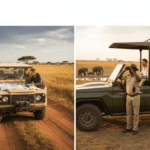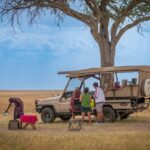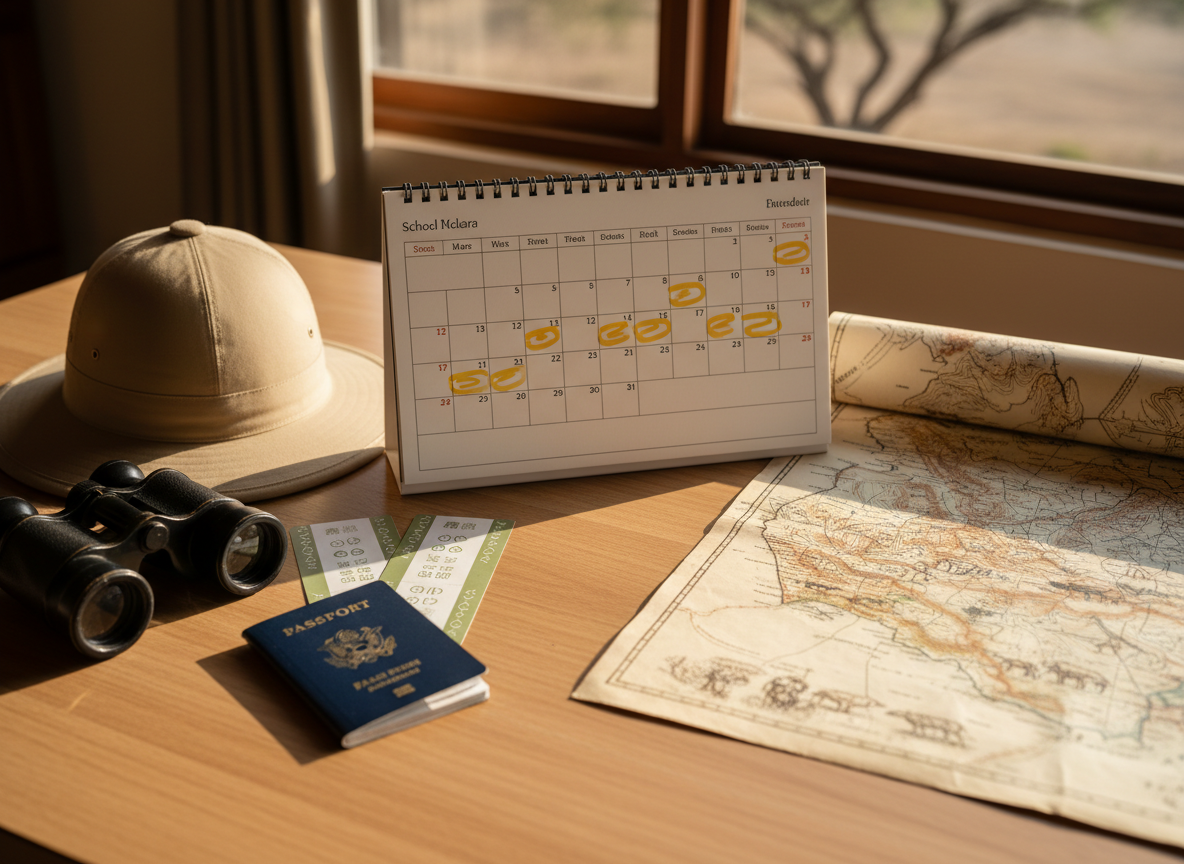
For families traveling with school-age children, safari timing is rarely a free choice. The school calendar sets the window, and that window usually falls in one of two places: the July to August peak or the December to January break. Both coincide with the most expensive and most heavily booked periods in Kenya’s national parks. Off-peak travel is cheaper and quieter, but it means pulling children from school. Understanding the school holiday vs off-peak safari trade-off is the central planning decision for any family heading to Kenya.
This article covers what each timing window delivers on the ground, where the costs and crowds sit, and which approach fits which kind of family.
What School Holiday Safari Season Actually Looks Like
The UK and European summer break (late July through August) is the single busiest period in the Masai Mara. It aligns with the peak of the Great Migration, when hundreds of thousands of wildebeest and zebra push north across the Mara River from Tanzania into Kenya. For families, this is the most dramatic possible introduction to East African wildlife.
The demand is intense. Well-placed camps require bookings nine to twelve months in advance. Daily rates run at their highest of the year. At popular river crossing sites, fifteen to thirty vehicles at a single sighting is not unusual.
December to January
The Christmas and New Year window is the secondary peak. Schools across the UK, US, and Australia break simultaneously, and families concentrate into a narrow band of travel dates. Availability tightens fast, and rates are high. The Mara is drier in December than in October or November, but the Great Migration has largely concluded by this point and the wildebeest herds have pushed south again.
The December window suits families who cannot travel in summer and are willing to accept resident wildlife rather than the Migration as the main attraction. Big Five sightings remain strong throughout the year.
What Peak Season Delivers
Even in crowd conditions, the July to August window is hard to argue against for first-time safari families. The Great Migration is the largest land-animal movement on earth. River crossings are unpredictable and extraordinary. Predator activity concentrates along the river because prey animals are abundant and cornered.
Families who book camps inside private conservancies rather than within the main reserve gain access to night drives, off-road driving, and walking safaris with an armed ranger. None of those are permitted inside the Masai Mara National Reserve. A conservancy camp removes much of the vehicle congestion and opens a substantially different set of experiences.
School Holiday vs Off-Peak Safari: What the Quiet Season Offers
Off-peak Kenya safari travel covers several distinct windows, each with its own character.
October and November bring the short rains. Afternoons often see brief showers, but mornings tend to be dry and clear. The landscape turns green, wildflowers cover the plains, and an extraordinary influx of migrant birds arrives from Europe and Central Asia. Newborn animals appear from October onward, making it one of the richer periods for watching animal behavior close-up.
January and February, outside the Christmas run-up, are dry and calm months with lower visitor numbers. The sparse dry-season vegetation makes wildlife easier to spot, and predator sightings are consistently strong.
April and May are the long rains. Some premium camps close during these months. Those that remain open drop rates significantly and operate at low occupancy. Game viewing remains productive, particularly for predators who use the tall grass to hunt.
What Families Gain in the Off-Peak Window
Pricing is the most immediate difference. Off-peak rates at Masai Mara camps typically run fifteen to forty percent below July to August peaks. For a family of four, that gap is significant, often enough to move to a better-positioned camp or add an extra night to the itinerary.
Fewer vehicles at sightings changes the character of the experience. A guide on a private vehicle can stop for as long as the family wants, let questions run, and explain what is happening without time pressure from other passengers or competing vehicles. Children engage more directly with wildlife behavior when the atmosphere is calm and unhurried.
Service in camps with lower occupancy tends to be more personal. Guides have time to structure drives around specific family interests, whether that means tracking a single leopard through the afternoon or watching an elephant herd for an hour at a waterhole.
The Term-Time Commitment
Off-peak travel for school-age children means taking them out of school during term time. In the UK, this requires a formal request to the headteacher. Some schools are flexible when the trip has clear educational value; others enforce absence rules and fines. Parents need to check their school’s specific policy before booking.
The educational case for a Kenya safari is straightforward. Natural history, ecology, geography, and cultural studies all connect to what children observe directly in the field. A child who has watched a river crossing and tracked a lion hunt has concrete reference points that carry through years of classroom learning.
Explorer Notes
Booking lead time matters more in peak season than most families expect. For July and August travel, nine to twelve months is the working minimum for good camp availability and private vehicle allocation. Families who start planning in March for a July departure will find limited options at the better properties.
Private game drives make a real difference at any time of year. Shared vehicles run a fixed schedule set for the group. A private drive adjusts to the children, stops when they are engaged, and moves on when attention drifts. On a three-hour morning drive, this flexibility matters more than most adults predict beforehand.
Conservancy camps outperform reserve camps for family experiences in peak season. The prohibition on night drives, off-road movement, and walking safaris inside the main reserve removes the most distinctive family activities. A camp on private conservancy land just outside the Mara boundary offers all of them.
Layering is essential on morning drives. The Masai Mara at dawn in July sits around fifteen to seventeen degrees Celsius. Open game drive vehicles move through cold air at speed. Midday reaches twenty-eight to thirty-two degrees. Children need a fleece for the early start and a light layer they can peel off by mid-morning.
A pair of binoculars per child changes the drive. Child-sized binoculars at seven or eight times magnification make distant sightings accessible. Children who can follow an animal independently stay engaged far longer than those who rely on adults to point out what is happening.
Conclusion
The school holiday vs off-peak safari decision does not have a single correct answer. Peak July to August travel delivers the Great Migration, maximum wildlife density, and the full range of operating camps, at the highest prices and with the most vehicle traffic. Off-peak travel brings quieter sightings, lower costs, and more personal camp experiences, but it requires a term-time commitment from both school and family.
Families who can only travel in school holidays should start planning early and prioritize private conservancy camps over sites inside the main reserve. Families with scheduling flexibility will find that a calm October or January trip to the Masai Mara is memorable in ways that peak-season crowds can obscure. The Great Migration is exceptional, but resident wildlife on a quiet morning in a private conservancy comes close.
Every trip described here can be tailored: dates, budget, camps, and pace built around you.
Get a Personalised SafariFurther reading
- Magical Kenya (Kenya Tourism Board)
- Kenya Wildlife Service
- Maasai Mara Wildlife Conservancies Association